
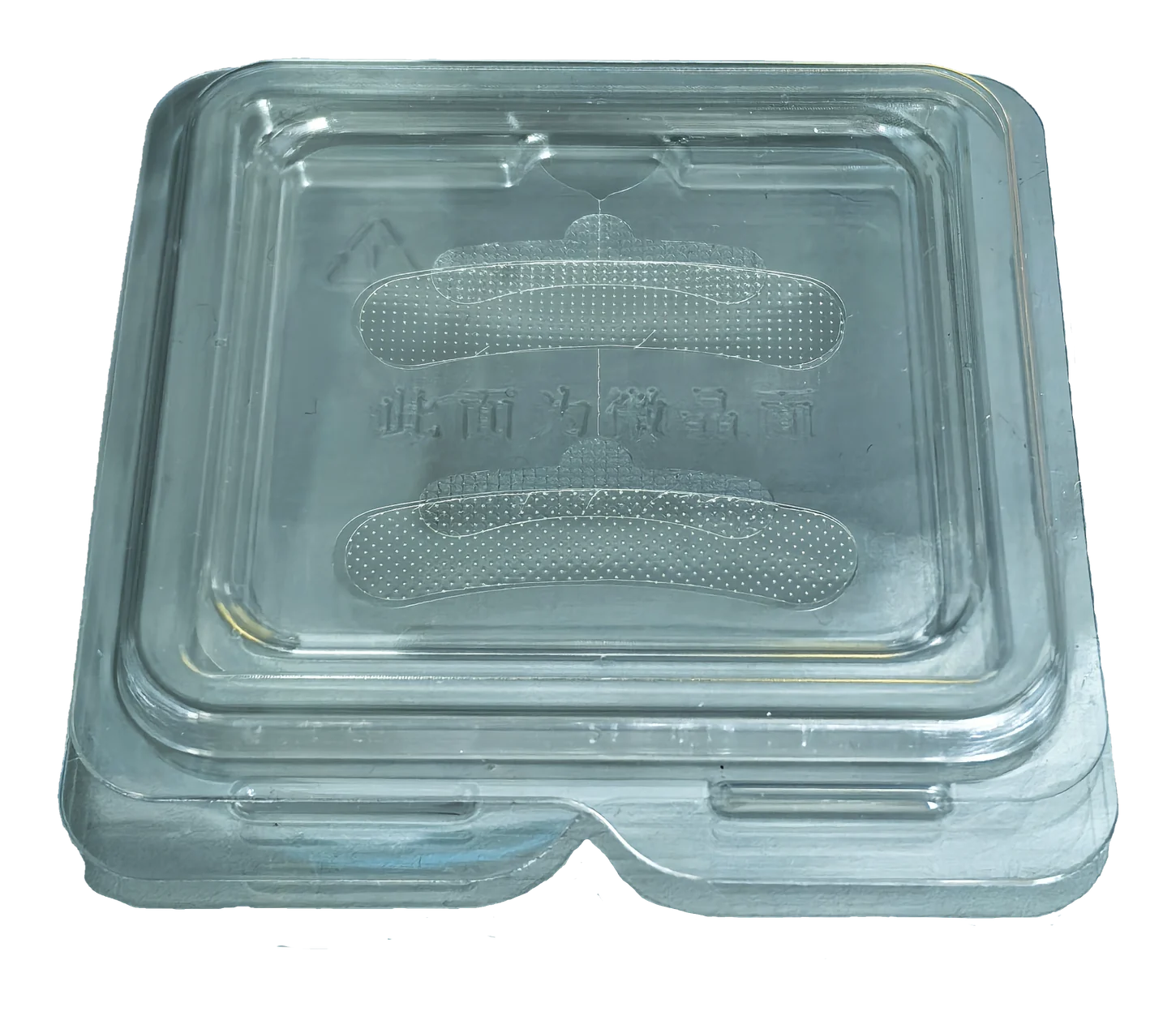
Use the actual contour
Include both large and small patch drawings and indicate whether each pair is mirrored. Rounded tips, inside curves and backing thickness affect the cavity and support points.
A shared tray can simplify packing while permitting more movement of a smaller patch. Compare how each shape sits, where it can touch, and whether handling remains intuitive.
Show where fingers reach
Mark the finger recess and which edge lifts first. Avoid placing that portion hard against an outer wall or seam.
For a lidded tray, assess whether the lid can be raised without pressing on the patch. For a tray inside a sachet, assess the angle needed to remove the loaded tray.
Approve inside the final sachet
A tray that fits an empty pouch may still distort the silhouette when it is loaded. Put the actual representative assembly inside a full-size prototype before reviewing it.
Check the two sizes for orientation after ordinary handling and transport tests selected for the project. Preserve a labelled pack with the approved arrangement.
- Large and small contours at scale
- Position of recess and lift area
- Final tray and sachet geometry reviewed together
Frequently asked questions
Can both eye-patch sizes share a tray?
Sometimes. Check cavity clearance, lift access and how each size is restrained in a filled prototype.